Tag: Divorce

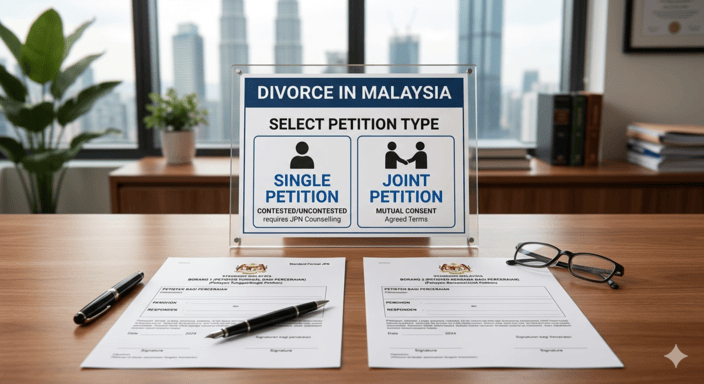
  • Divorce in Malaysia: Understanding the Difference Between Joint and Single Petitions

    Divorce in Malaysia: Understanding the Difference Between Joint and Single Petitions

    When people first consider divorce, one of the most common questions they ask is:

    “Should I file a Joint Petition or a Single Petition?”

    While this appears to be the most important decision at the beginning of the process, it is often not the right question.

    In practice, many individuals do not encounter difficulties because they chose the wrong type of divorce proceeding. Rather, they encounter difficulties because they misunderstand the sequence of steps involved and commence the process without first understanding their legal position.

    A clear understanding of the available options can save significant time, expense and emotional stress.

    Joint Petition: When Both Parties Agree

    A Joint Petition is generally the most straightforward method of obtaining a divorce.

    As its name suggests, both spouses jointly apply to the Court for the dissolution of the marriage.

    This option is typically available where both parties have already agreed that the marriage has irretrievably broken down and have reached agreement on the key issues arising from the separation.

    These issues commonly include matters such as custody of children, access arrangements, maintenance and the division of matrimonial assets.

    Because the parties have already reached an agreement, the Court’s role is largely focused on reviewing the terms and determining whether the proposed arrangements are appropriate and lawful.

    In most cases, a Joint Petition is faster, less costly and considerably less stressful than contested proceedings.

    For that reason, where an amicable resolution is possible, it is often the preferred option.

    Single Petition: When Agreement Is Not Possible

    Not every marriage ends on mutually agreeable terms.

    There are many situations where one spouse refuses to cooperate, disputes the divorce, delays discussions or simply cannot be located.

    In such circumstances, a Single Petition may become necessary.

    Unlike a Joint Petition, a Single Petition is commenced by one spouse without the agreement of the other.

    Because the proceedings are contested, the Court will ultimately be required to consider the evidence and determine whether the legal requirements for divorce have been satisfied.

    Single Petition proceedings are generally more time-consuming and involve a greater degree of procedural complexity than a Joint Petition.

    For this reason, legal advice is particularly important before commencing such proceedings.

    The Role of the Marriage Tribunal and KC28

    Many people have heard of a document commonly referred to as “KC28” but are uncertain about its purpose.

    The KC28 is essentially a certificate issued following the failure of reconciliation efforts conducted through the Marriage Tribunal established under the relevant legal framework.

    Its purpose is to demonstrate that attempts at reconciliation have been made but have not succeeded.

    In many non-Muslim divorce matters, this certificate forms an important part of the process before contested divorce proceedings may proceed. However, there are statutory exceptions, and the requirement does not apply in every case.

    Whether a KC28 certificate is required depends on the specific facts and legal circumstances involved.

    As a result, professional advice should always be obtained before assuming that attendance before the Tribunal is mandatory.

    Where Children Are Involved

    In our experience, the most difficult disputes in divorce proceedings rarely concern the divorce itself.

    More often, they concern the children.

    Questions regarding custody, care arrangements, visitation rights and maintenance frequently become the central issues between the parties.

    For this reason, where children are involved, it is often beneficial to focus on resolving parenting arrangements as early as possible.

    Once practical arrangements concerning the children have been agreed upon, many couples find that the remaining issues become easier to resolve.

    In some situations, matters that initially appeared destined for contested proceedings ultimately proceed by way of a Joint Petition after agreement has been reached on issues affecting the children.

    This approach often reduces conflict and allows both parties to focus on the long-term welfare of their children.

    Why Timing Matters

    One reality of family law practice is that delay can sometimes become a strategy.

    Many individuals have experienced situations where discussions continue indefinitely without any real progress.

    Promises are made to revisit the issue later. Decisions are postponed. Months turn into years.

    Meanwhile, uncertainty continues.

    One reason lawyers frequently advise clients to understand and, where appropriate, commence the correct legal process is to prevent matters from remaining unresolved indefinitely.

    The objective is not to create conflict but to establish a clear framework within which issues can be addressed and resolved.

    Understanding the Process Before Taking Action

    Every divorce matter is different.

    Some cases can be resolved through cooperation and mutual agreement. Others require judicial intervention. Some involve complex financial issues. Others revolve primarily around parenting arrangements.

    The key is not to assume that every divorce follows the same path.

    Before deciding whether to pursue a Joint Petition or a Single Petition, it is important to understand the legal requirements, the available options and the practical consequences of each approach.

    A properly planned strategy at the beginning of the process often prevents unnecessary complications later.

    Divorce Is Not Merely a Legal Procedure

    It is important to remember that divorce is not simply about ending a marriage.

    It often involves decisions that will affect housing arrangements, financial security, parental responsibilities and the future well-being of children.

    For that reason, the objective should never be to complete the process as quickly as possible at any cost.

    The objective should be to ensure that the process is handled properly and that the long-term consequences are carefully considered.

    Conclusion

    The distinction between a Joint Petition and a Single Petition is important, but it is only one part of the overall picture.

    The more important question is whether the process has been approached in the correct manner from the outset.

    Where agreement is possible, a Joint Petition will often provide the most efficient and cost-effective solution.

    Where agreement is not possible, a Single Petition may be necessary to move matters forward and allow the Court to determine the issues in dispute.

    Ultimately, understanding the procedure is not about encouraging divorce.

    It is about ensuring that when individuals find themselves facing one of the most difficult periods of their lives, they are able to make informed decisions and avoid unnecessary mistakes.

    In family law matters, the right first step often determines the entire journey that follows.

  • Unpaid Maintenance in Malaysia: What Can You Do If Your Former Spouse Refuses to Pay?

    Unpaid Maintenance in Malaysia: What Can You Do If Your Former Spouse Refuses to Pay?

    One of the most common concerns raised by divorced spouses is surprisingly straightforward:

    “What happens if my former husband simply refuses to pay maintenance?”

    For many parents, maintenance is not merely a legal entitlement. It is money needed to pay school expenses, daily necessities, rent, transport costs and the ordinary expenses of raising children.

    Unfortunately, it is not uncommon for maintenance payments to stop after a period of time. Some former spouses make irregular payments. Others reduce the amount without agreement. Some simply stop paying altogether.

    When this happens, many recipients feel frustrated and helpless. Some assume that obtaining a court order is meaningless if the other party chooses to ignore it.

    That assumption is incorrect.

    A maintenance order is not a request. It is a court order. Malaysian law provides several mechanisms to enforce it.

    Maintenance Orders Are Legally Enforceable

    Many people mistakenly believe that maintenance depends on the goodwill of the paying spouse.

    It does not.

    Once a maintenance order has been granted by the Court, compliance becomes a legal obligation. Failure to comply may expose the defaulting party to various enforcement proceedings.

    The law recognizes that maintenance is often essential for the welfare of children and the financial security of the receiving spouse.

    For that reason, the courts are equipped with powers to compel compliance.

    Do Not Delay Taking Action

    One of the most important issues that many people overlook concerns time.

    Under Section 86(3) of the Law Reform (Marriage and Divorce) Act 1976, issues relating to arrears of maintenance may be affected by the period that has elapsed before enforcement is pursued.

    As a practical matter, individuals should seek advice and take action as soon as substantial arrears begin to accumulate.

    The longer enforcement is delayed, the more complicated recovery may become.

    In maintenance matters, delay often benefits the defaulting party rather than the recipient.

    Judgment Debtor Summons: Often the First Enforcement Step

    One of the most commonly used enforcement mechanisms is the Judgment Debtor Summons.

    Through this procedure, the defaulting party is required to attend court and explain why the maintenance order has not been complied with.

    The Court may inquire into the individual’s income, assets, employment status and financial circumstances. Depending on the evidence presented, the Court may make further orders regarding payment of the arrears, including structured repayment arrangements.

    The process places the issue directly before a judge and requires the defaulting party to account for the non-payment.

    In many cases, the prospect of having to explain one’s financial position in open court encourages compliance.

    Garnishee Proceedings: Recovering Money Directly

    Where the recipient knows that the defaulting party maintains funds in a bank account or is owed money by a third party, garnishee proceedings may be available.

    This is one of the more powerful enforcement tools available under Malaysian law.

    A garnishee order allows the Court, in appropriate circumstances, to direct a third party, such as a bank, to pay money towards satisfaction of the judgment debt.

    Many people describe this process as “freezing a bank account.” In reality, the legal objective is not simply to freeze funds but to redirect available monies towards payment of the outstanding debt.

    Where successful, this can be an effective method of recovering maintenance arrears.

    Non-Compliance May Lead to Contempt Proceedings

    There are situations where a former spouse deliberately and persistently ignores a maintenance order despite having the ability to comply.

    In appropriate cases, contempt of court proceedings may be considered.

    The basis for such proceedings is straightforward. A maintenance order is a court order. Deliberate disobedience of a court order may constitute contempt of court.

    Contempt proceedings are serious. The Court will generally examine whether the defaulting party had knowledge of the order and whether the failure to comply was wilful.

    Where contempt is established, the Court possesses a range of powers, including the power to impose sanctions designed to uphold the authority of the Court and secure compliance with its orders.

    Do Not Assume Enforcement Is Too Expensive

    A common reason why maintenance arrears remain unpaid is that recipients assume enforcement proceedings will be prohibitively expensive or excessively complicated.

    In practice, every case is different.

    The appropriate procedure depends on the amount owed, the financial circumstances of the parties and the available evidence.

    Obtaining advice does not automatically mean commencing proceedings. It simply allows a person to understand the available options, the likely costs and the potential outcomes before making a decision.

    Many individuals discover that they have more legal remedies available than they initially realized.

    Maintenance Is About Responsibility

    Maintenance claims are often misunderstood as personal disputes between former spouses.

    In reality, maintenance serves a broader purpose.

    For children, maintenance provides financial support for their upbringing, education and welfare. For former spouses entitled to maintenance, it represents compliance with legal obligations imposed by the Court.

    Seeking enforcement is not an act of revenge.

    It is not harassment.

    It is not an attempt to prolong conflict.

    It is the lawful enforcement of a court order that exists to protect those whom the law recognizes as requiring support.

    Conclusion

    A maintenance order has little value if it remains unenforced.

    Fortunately, Malaysian law provides mechanisms to compel compliance, including Judgment Debtor Summons proceedings, garnishee proceedings and, in appropriate circumstances, contempt proceedings.

    The most important lesson is simple: do not wait.

    The longer arrears accumulate, the more difficult recovery may become. Early action often provides the greatest opportunity for a successful outcome.

    Maintenance is not a favor.

    It is a legal obligation.

    And where that obligation is ignored, the law provides remedies.

  • Divorce and Property Division in Malaysia: Why “Half and Half” Is Often a Myth

    One of the most common misconceptions about divorce is that all assets will automatically be divided equally between husband and wife.

    Many people enter divorce proceedings believing that the law guarantees a fifty-fifty split. Others assume that whoever’s name appears on the title of a property automatically owns it outright.

    In practice, neither assumption is necessarily correct.

    After handling family law matters for many years, one reality remains consistent: many people do not suffer financial loss because of the divorce itself. They suffer because they misunderstand how property division actually works.

    Understanding the legal principles governing matrimonial assets is often the difference between making informed decisions and making costly mistakes.

    Divorce Does Not Automatically Mean a 50:50 Division

    The starting point under Malaysian family law is not an automatic equal division of assets.

    When determining how matrimonial assets should be divided, the Court generally considers a range of factors, including the financial contributions made by each spouse, non-financial contributions to the family, the needs of any children and the overall circumstances of the marriage.

    The Court’s objective is not simply to divide assets equally. Its objective is to achieve a fair outcome based on the evidence before it.

    As a result, property division is highly dependent on the specific facts of each case.

    Joint Ownership Does Not Guarantee Equal Entitlement

    Many married couples purchase properties in their joint names.

    While joint ownership is an important factor, it does not automatically determine how the property will be divided upon divorce.

    The Court may examine who paid the deposit, who serviced the mortgage, who contributed towards household expenses and whether one spouse made indirect contributions by caring for the family and supporting the household.

    The legal title provides part of the picture, but it is rarely the entire picture.

    Property division ultimately depends upon the Court’s assessment of both direct and indirect contributions throughout the marriage.

    The Presence of Children Often Changes the Analysis

    When children are involved, the Court’s focus extends beyond the financial interests of the parties.

    The welfare of the children remains a significant consideration.

    In many cases, the immediate question is not who should ultimately own the family home but whether the children should continue to have stable accommodation and continuity in their daily lives.

    As a result, practical arrangements are sometimes made to allow the primary caregiver and children to remain in occupation of a property while longer-term ownership issues are addressed separately.

    Every case is different, but the welfare of the children frequently influences the overall outcome.

    Selling the Property Is Not Always the Best Solution

    During divorce proceedings, parties often assume that the fairest solution is to sell the matrimonial home and divide the proceeds.

    However, the practical realities are often more complicated.

    Many properties remain subject to substantial mortgage liabilities. After the outstanding loan, legal fees, real estate commissions and related costs are deducted, the remaining proceeds may be significantly lower than expected.

    In some situations, preserving housing stability for the children may provide greater long-term benefit than an immediate sale.

    The question is not merely whether a property can be sold. The question is whether selling it actually improves the position of those affected by the divorce.

    Properties Held in One Spouse’s Name Are Not Automatically Excluded

    Another misconception is that a property registered solely in one spouse’s name automatically belongs exclusively to that spouse.

    This is not necessarily correct.

    If the property was acquired during the marriage and there is evidence that both parties contributed directly or indirectly towards the acquisition, maintenance or preservation of the asset, the Court may treat it as a matrimonial asset.

    The fact that legal ownership rests in one person’s name does not automatically prevent the other spouse from asserting a claim.

    The Court will examine the substance of the parties’ contributions rather than relying solely on the registered title.

    Vehicles Are Often Treated Differently from Real Property

    Motor vehicles are generally assessed in a more practical manner.

    The Court will often consider factors such as who primarily uses the vehicle, who requires it for work or childcare responsibilities and who is able to maintain the associated expenses.

    A vehicle may be an asset, but it also carries ongoing financial obligations, including loan repayments, insurance, road tax and maintenance costs.

    For this reason, receiving a vehicle as part of a settlement is not always as advantageous as it may initially appear.

    Business Interests and Company Shares Require Separate Analysis

    Business assets often create some of the most complex disputes in divorce proceedings.

    Many people assume that a spouse automatically becomes entitled to half of a company’s shares upon divorce.

    The legal position is considerably more nuanced.

    The Court may consider issues such as how the company was established, whether the business existed before the marriage, the extent of each spouse’s involvement and the nature of any direct or indirect contributions made to the growth of the enterprise.

    Each case turns on its own facts, and business interests frequently require careful valuation and analysis before any division can be considered.

    Homemakers Make Valuable Contributions

    Perhaps one of the most important developments in modern family law is the recognition that contributions to a marriage are not measured solely in financial terms.

    A spouse who sacrifices career opportunities to raise children, manage the household and support the family may have made substantial contributions to the acquisition and preservation of matrimonial assets.

    The law recognises that a family functions because of both financial and non-financial efforts.

    Accordingly, the absence of direct financial contributions does not necessarily prevent a spouse from receiving a share of matrimonial assets.

    Family contributions have legal value.

    The Most Expensive Words in a Divorce

    One statement appears repeatedly in divorce matters:

    “I don’t want anything. I just want this over quickly.”

    While understandable during an emotionally difficult period, decisions made in haste often become sources of regret later.

    Property settlements affect not only the immediate aftermath of a divorce but also future financial security, housing arrangements and long-term stability.

    For that reason, major decisions should be made after careful consideration rather than emotional exhaustion.

    Divorce Is Not About Winning

    Property division is often viewed as a contest between husband and wife.

    In reality, the legal process serves a different purpose.

    The Court is not distributing rewards or imposing punishments. It is attempting to achieve a fair allocation of assets accumulated during the marriage while taking into account the interests of all parties involved, particularly any children.

    For that reason, divorce should not be approached as a battle for victory. It should be approached as a process of restructuring lives, responsibilities and financial arrangements for the future.

    Conclusion

    Divorce is rarely just about ending a marriage.

    It involves decisions relating to housing, finances, children, business interests and long-term security. The consequences of those decisions may continue for many years after the divorce itself has been finalised.

    Understanding the law governing matrimonial assets is therefore essential.

    The objective is not to gain an advantage over the other party. The objective is to ensure that important decisions are made with full knowledge of the legal implications and long-term consequences.

    Because in many divorce cases, the greatest regret is not the end of the marriage.

    It is discovering too late what could have been protected.

  • Divorce and Infidelity in Malaysia: Why Evidence Matters More Than Emotion

    Divorce and Infidelity in Malaysia: Why Evidence Matters More Than Emotion

    Few experiences are as emotionally devastating as discovering that a spouse may be involved in an affair.

    For some, the discovery comes unexpectedly through a message, a phone call or a chance encounter. Others begin noticing changes in behavior, unexplained absences or inconsistencies that gradually raise suspicion. Regardless of how the truth emerges, the emotional impact is often immediate and overwhelming.

    Anger, betrayal, confusion and a desire for immediate answers are entirely understandable reactions.

    However, from a legal perspective, one of the most important realities is this: many cases involving allegations of infidelity are not weakened by the law itself. They are weakened by the decisions made in the immediate aftermath of the discovery.

    In emotionally charged situations, people often act before they think. Unfortunately, those first reactions can sometimes make it more difficult to establish the facts later.

    What Does the Court Actually Consider?

    Many people believe that adultery can only be proven through direct evidence or by catching a spouse and a third party in an intimate situation.

    In reality, civil courts do not operate on that basis.

    The Court’s task is to examine the evidence and determine which version of events is more likely than not to be true. The standard of proof is known as the balance of probabilities.

    In simple terms, the Court asks whether the evidence, taken as a whole, makes one explanation more probable than the other.

    As a result, successful cases often depend not on a single dramatic piece of evidence, but on a collection of facts that point towards a consistent and reasonable conclusion.

    Conduct Often Speaks Louder Than Words

    In many cases, allegations of infidelity are established through patterns of behavior rather than admissions.

    The Court may consider evidence showing frequent overnight stays, repeated private meetings, cohabitation, travel arrangements, witness testimony or other circumstances suggesting a relationship that extends beyond friendship.

    A single incident may not be sufficient. However, when multiple pieces of evidence point in the same direction, the overall picture may become compelling.

    The Court is generally concerned with patterns, consistency and probability rather than isolated suspicions.

    Documentary Evidence Is Often the Most Persuasive

    While emotional confrontations frequently dominate personal disputes, courts tend to place greater weight on objective evidence.

    Messages, emails, travel records, hotel records, tenancy documents, photographs, financial transactions and other contemporaneous records may all be relevant depending on the circumstances.

    Importantly, context matters.

    A single screenshot rarely tells the full story. Courts are often more interested in complete conversations, timelines and supporting documentation that can be independently verified.

    The stronger the documentary evidence, the less reliance there is on speculation or assumption.

    The Most Common Mistake After Discovery

    One of the most frequent mistakes occurs immediately after suspicions arise.

    Many people instinctively confront their spouse, demand explanations or inform family members and friends before properly understanding the facts.

    While such reactions are understandable, they can have unintended consequences.

    Electronic evidence may be deleted. Communication patterns may change. Accounts may be closed. Explanations may be rehearsed. Potential witnesses may become reluctant to become involved.

    When legal proceedings eventually commence, emotions remain strong, but the available evidence may be significantly weaker than it could have been.

    This does not mean individuals should secretly investigate their spouses or engage in unlawful conduct. It simply highlights the importance of acting carefully and obtaining proper advice before making significant decisions.

    Timing Can Be Important

    Another reality that is often overlooked is the significance of timing.

    Some individuals choose to forgive, reconcile or postpone action in the hope that the situation will improve. Every family situation is unique, and many couples successfully rebuild their relationships after periods of difficulty.

    However, where legal proceedings are eventually contemplated, delays may affect the availability of evidence and the overall strength of a case.

    As time passes, records may disappear, memories may fade and circumstances may change.

    For this reason, individuals facing serious marital difficulties should understand their legal position before making long-term decisions.

    The Legal Consequences Extend Beyond Damages

    Public discussion about infidelity cases often focuses on financial compensation. In practice, however, legal proceedings are rarely only about money.

    The existence of credible evidence may influence negotiations relating to divorce, settlement discussions and the overall management of the dispute.

    Well-prepared cases often place parties in a stronger position when attempting to resolve matters without prolonged litigation.

    Ultimately, the strength of a legal case is rarely determined by emotion. It is determined by evidence.

    Protecting Yourself During a Difficult Time

    Infidelity allegations are among the most sensitive issues encountered in family law.

    Every case is different. Some suspicions prove justified. Others do not. For that reason, assumptions should never replace evidence.

    When emotions are at their highest, individuals often feel pressure to act immediately. Yet the most effective legal decisions are usually made after careful consideration rather than emotional reaction.

    Understanding your legal rights does not mean pursuing revenge. It means ensuring that important decisions are made with clarity, proper information and an appreciation of the consequences that may follow.

    In many situations, the greatest protection a person can give themselves is not anger, confrontation or public accusations.

    It is patience, evidence and informed legal advice.

    Because when a dispute eventually reaches the courtroom, the Court will not decide the case based on who was angrier, louder or more hurt.

    The Court will decide it based on what can be proven.