Author: admin

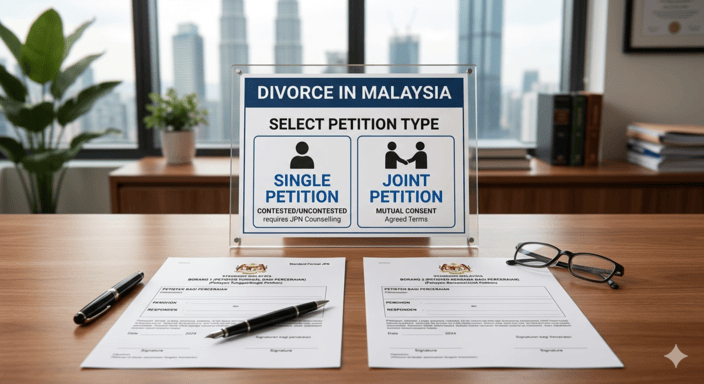
  • Divorce in Malaysia: Understanding the Difference Between Joint and Single Petitions

    Divorce in Malaysia: Understanding the Difference Between Joint and Single Petitions

    When people first consider divorce, one of the most common questions they ask is:

    “Should I file a Joint Petition or a Single Petition?”

    While this appears to be the most important decision at the beginning of the process, it is often not the right question.

    In practice, many individuals do not encounter difficulties because they chose the wrong type of divorce proceeding. Rather, they encounter difficulties because they misunderstand the sequence of steps involved and commence the process without first understanding their legal position.

    A clear understanding of the available options can save significant time, expense and emotional stress.

    Joint Petition: When Both Parties Agree

    A Joint Petition is generally the most straightforward method of obtaining a divorce.

    As its name suggests, both spouses jointly apply to the Court for the dissolution of the marriage.

    This option is typically available where both parties have already agreed that the marriage has irretrievably broken down and have reached agreement on the key issues arising from the separation.

    These issues commonly include matters such as custody of children, access arrangements, maintenance and the division of matrimonial assets.

    Because the parties have already reached an agreement, the Court’s role is largely focused on reviewing the terms and determining whether the proposed arrangements are appropriate and lawful.

    In most cases, a Joint Petition is faster, less costly and considerably less stressful than contested proceedings.

    For that reason, where an amicable resolution is possible, it is often the preferred option.

    Single Petition: When Agreement Is Not Possible

    Not every marriage ends on mutually agreeable terms.

    There are many situations where one spouse refuses to cooperate, disputes the divorce, delays discussions or simply cannot be located.

    In such circumstances, a Single Petition may become necessary.

    Unlike a Joint Petition, a Single Petition is commenced by one spouse without the agreement of the other.

    Because the proceedings are contested, the Court will ultimately be required to consider the evidence and determine whether the legal requirements for divorce have been satisfied.

    Single Petition proceedings are generally more time-consuming and involve a greater degree of procedural complexity than a Joint Petition.

    For this reason, legal advice is particularly important before commencing such proceedings.

    The Role of the Marriage Tribunal and KC28

    Many people have heard of a document commonly referred to as “KC28” but are uncertain about its purpose.

    The KC28 is essentially a certificate issued following the failure of reconciliation efforts conducted through the Marriage Tribunal established under the relevant legal framework.

    Its purpose is to demonstrate that attempts at reconciliation have been made but have not succeeded.

    In many non-Muslim divorce matters, this certificate forms an important part of the process before contested divorce proceedings may proceed. However, there are statutory exceptions, and the requirement does not apply in every case.

    Whether a KC28 certificate is required depends on the specific facts and legal circumstances involved.

    As a result, professional advice should always be obtained before assuming that attendance before the Tribunal is mandatory.

    Where Children Are Involved

    In our experience, the most difficult disputes in divorce proceedings rarely concern the divorce itself.

    More often, they concern the children.

    Questions regarding custody, care arrangements, visitation rights and maintenance frequently become the central issues between the parties.

    For this reason, where children are involved, it is often beneficial to focus on resolving parenting arrangements as early as possible.

    Once practical arrangements concerning the children have been agreed upon, many couples find that the remaining issues become easier to resolve.

    In some situations, matters that initially appeared destined for contested proceedings ultimately proceed by way of a Joint Petition after agreement has been reached on issues affecting the children.

    This approach often reduces conflict and allows both parties to focus on the long-term welfare of their children.

    Why Timing Matters

    One reality of family law practice is that delay can sometimes become a strategy.

    Many individuals have experienced situations where discussions continue indefinitely without any real progress.

    Promises are made to revisit the issue later. Decisions are postponed. Months turn into years.

    Meanwhile, uncertainty continues.

    One reason lawyers frequently advise clients to understand and, where appropriate, commence the correct legal process is to prevent matters from remaining unresolved indefinitely.

    The objective is not to create conflict but to establish a clear framework within which issues can be addressed and resolved.

    Understanding the Process Before Taking Action

    Every divorce matter is different.

    Some cases can be resolved through cooperation and mutual agreement. Others require judicial intervention. Some involve complex financial issues. Others revolve primarily around parenting arrangements.

    The key is not to assume that every divorce follows the same path.

    Before deciding whether to pursue a Joint Petition or a Single Petition, it is important to understand the legal requirements, the available options and the practical consequences of each approach.

    A properly planned strategy at the beginning of the process often prevents unnecessary complications later.

    Divorce Is Not Merely a Legal Procedure

    It is important to remember that divorce is not simply about ending a marriage.

    It often involves decisions that will affect housing arrangements, financial security, parental responsibilities and the future well-being of children.

    For that reason, the objective should never be to complete the process as quickly as possible at any cost.

    The objective should be to ensure that the process is handled properly and that the long-term consequences are carefully considered.

    Conclusion

    The distinction between a Joint Petition and a Single Petition is important, but it is only one part of the overall picture.

    The more important question is whether the process has been approached in the correct manner from the outset.

    Where agreement is possible, a Joint Petition will often provide the most efficient and cost-effective solution.

    Where agreement is not possible, a Single Petition may be necessary to move matters forward and allow the Court to determine the issues in dispute.

    Ultimately, understanding the procedure is not about encouraging divorce.

    It is about ensuring that when individuals find themselves facing one of the most difficult periods of their lives, they are able to make informed decisions and avoid unnecessary mistakes.

    In family law matters, the right first step often determines the entire journey that follows.

  • Security Deposits Are Not Yours to Keep: Lessons from a Successful Appeal

    Security Deposits Are Not Yours to Keep: Lessons from a Successful Appeal

    One of the most common misconceptions in tenancy disputes is the belief that a landlord is automatically entitled to retain a tenant’s security deposit whenever allegations of damage are made.

    Many landlords genuinely believe that once a tenancy ends, they may simply deduct whatever amount they consider appropriate from the deposit, provided they assert that the property was returned in a damaged condition.

    The law does not operate in that manner.

    A recent matter that we successfully argued before the Court of Appeal serves as an important reminder that a security deposit is not a discretionary fund that a landlord may utilise at will. The right to retain or deduct from a security deposit must be supported by evidence, proper assessment and compliance with the contractual framework agreed upon by the parties.

    The Dispute

    The dispute concerned a tenant whose security deposit had been withheld following the termination of the tenancy.

    The landlord alleged that damage had been caused to the premises and sought to justify the retention of the deposit on that basis.

    However, a closer examination of the facts revealed a significant problem.

    There had been no proper joint inspection conducted between the parties. There was no meaningful assessment of the alleged damage. There was no independent evaluation of the condition of the premises and no satisfactory evidence establishing the extent of any loss allegedly suffered.

    Despite this, the deposit continued to be withheld.

    The issue before the Court was therefore not merely whether damage existed. The more important question was whether the landlord had established a lawful basis for retaining the tenant’s money.

    The Court of Appeal’s Decision

    The Court of Appeal accepted our client’s position and reaffirmed established legal principles governing the treatment of security deposits.

    The Court recognised that allegations alone are insufficient.

    A landlord who wishes to retain a tenant’s security deposit must be able to demonstrate a proper basis for doing so. The existence of damage cannot simply be assumed. It must be established through evidence.

    The decision reinforces an important principle that applies to both residential and commercial tenancies: a security deposit is not automatically forfeited merely because a dispute arises at the end of a tenancy.

    The burden remains on the party seeking to make deductions to justify those deductions properly.

    The Importance of Contractual Procedures

    The Court’s reasoning was consistent with principles previously recognised in Malaysian jurisprudence.

    In International Islamic University Malaysia v Elemen Garisan Sdn Bhd, the Court emphasised the importance of complying with contractual mechanisms governing inspections, assessments and the determination of loss.

    Where a contract provides for a particular process to be followed, parties are generally expected to adhere to that process.

    A landlord cannot simply bypass agreed procedures and unilaterally determine the amount to be deducted from a tenant’s deposit.

    Similarly, in Berjaya Times Square Sdn Bhd v Twingems Sdn Bhd, the courts reiterated the broader principle that parties must act in accordance with the law and the contractual framework governing their relationship.

    Even where a breach may have occurred, self-help remedies are not automatically available.

    Rights must be exercised through proper legal channels.

    The Issue of Self-Help and Changing Locks

    One particularly concerning aspect of the case involved the landlord’s conduct in changing the locks to the premises without first obtaining any court order.

    This issue is often misunderstood.

    Many property owners assume that if they believe a tenant has breached the tenancy agreement, they are entitled to immediately take possession of the premises by excluding the tenant.

    That assumption is dangerous.

    Possession of property is a legal right protected by law. A landlord who wishes to recover possession must generally follow the procedures prescribed by law and the tenancy agreement.

    Simply changing locks and preventing access without proper legal authority may itself expose the landlord to liability.

    The existence of a dispute does not permit a party to bypass legal procedures.

    The rule of law applies equally to landlords and tenants.

    Damage Must Be Proven, Not Assumed

    Perhaps the most important lesson from this case is that the existence of damage is ultimately an evidential issue.

    The question is not whether a landlord believes damage occurred.

    The question is whether the alleged damage can be proven.

    A proper claim for deductions from a security deposit should ordinarily be supported by evidence demonstrating the condition of the premises, the nature of the damage, the cost of rectification and the basis upon which the deductions are calculated.

    Photographs, inspection reports, quotations, invoices and contemporaneous records frequently play an important role in this assessment.

    Without evidence, allegations remain allegations.

    The law requires more.

    Security Deposits Are Held as Security, Not as Ownership

    A further misconception is that a security deposit becomes the landlord’s money once it has been paid.

    That is not the legal position.

    A security deposit is generally held as security against legitimate claims arising under the tenancy. It remains subject to the contractual rights and obligations of the parties.

    The landlord may have a right to make deductions where justified. However, the existence and extent of those deductions must be established properly.

    The deposit cannot simply be treated as an additional source of income or a convenient solution to unresolved disputes.

    Conclusion

    This case serves as a useful reminder that rights must be exercised through lawful means and supported by evidence.

    A landlord may be entitled to recover genuine losses caused by a tenant. Equally, a tenant is entitled to challenge deductions that cannot be properly justified.

    The existence of a security deposit does not eliminate the need for proof.

    Nor does it authorise a party to take unilateral action outside the legal framework governing the tenancy.

    Ultimately, the issue is not whether damage is alleged.

    The issue is whether the damage can be proven.

    In tenancy disputes, that distinction often determines the outcome of the case.

    The Court of Appeal’s decision reinforces a principle that is both simple and important: having a right is one thing; exercising that right lawfully is another.

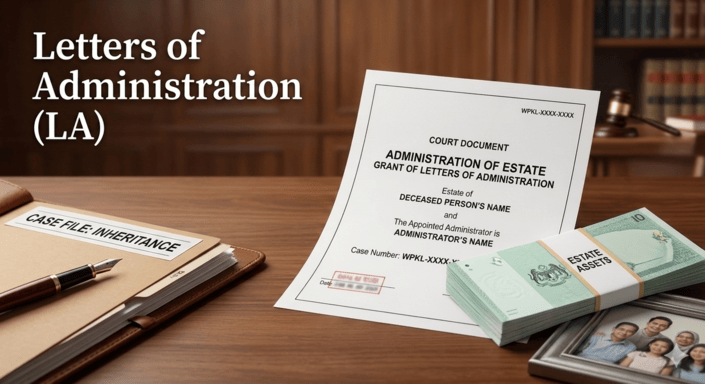
  • Letters of Administration (LA) in Malaysia: A Practical Guide to Estate Administration Without a Will

    Letters of Administration (LA) in Malaysia: A Practical Guide to Estate Administration Without a Will

    When a loved one passes away without leaving a valid will, one of the first legal questions the family will face is this:

    Who has the legal authority to deal with the deceased’s assets?

    Many people assume that a spouse or child can automatically access bank accounts, transfer property or deal with the deceased’s affairs. Unfortunately, that is not how the law operates.

    In Malaysia, where a person passes away without a will, the family will generally need to obtain a Letter of Administration (“LA”) before the estate can be properly administered.

    Understanding the purpose of an LA and the process involved can save families significant time, expense and unnecessary disputes.

    What Is a Letter of Administration?

    A Letter of Administration is a court order issued by the High Court authorising one or more individuals to administer the estate of a deceased person who died without a valid will.

    The person appointed by the Court is known as an administrator.

    Once appointed, the administrator assumes legal responsibility for collecting the deceased’s assets, settling liabilities, dealing with financial institutions, managing estate matters and ultimately distributing the estate to the rightful beneficiaries in accordance with the law.

    Without an LA, family members often discover that they have no legal authority to deal with the deceased’s assets, even if they are the spouse or children of the deceased.

    When Is a Letter of Administration Required?

    A Letter of Administration is commonly required whenever a deceased person leaves behind assets but does not leave a valid will appointing an executor.

    In practice, applications are frequently necessary where the deceased owned real property, maintained bank accounts, held investments, owned motor vehicles or left behind other significant assets that cannot be transferred without formal legal authority.

    The larger or more complex the estate, the more likely it is that an LA will be required.

    Who Can Apply?

    The Court generally gives priority to individuals who have a legitimate interest in the estate.

    In most cases, applications are made by a surviving spouse, children, parents or other close family members.

    The objective is to appoint a suitable individual who is capable of administering the estate responsibly and in the interests of all beneficiaries.

    The Court’s concern is not merely who wishes to act, but whether the proposed administrator is appropriate for the role.

    Choosing the Right Administrator

    Although the law permits multiple administrators to be appointed, practical experience often demonstrates that more administrators do not necessarily result in a smoother administration process.

    Every significant decision generally requires cooperation between the administrators.

    Where disagreements arise, estate administration can become delayed and increasingly complicated.

    For this reason, careful consideration should be given to the number of administrators proposed. The objective should be efficient administration rather than unnecessary complexity.

    The First Priority Is Identifying the Beneficiaries

    One of the most common misunderstandings is that the first issue to resolve is how the estate will be divided.

    In reality, the first task is often determining who is legally entitled to benefit from the estate.

    Before assets can be distributed, the beneficiaries must be properly identified and their relationship to the deceased established.

    This forms the foundation upon which the entire administration process is built.

    Renunciation Does Not Mean Giving Up an Inheritance

    Where several family members are entitled to apply for the grant, it is common for some individuals to choose not to act as administrators.

    In such circumstances, renunciation documents may be executed.

    A renunciation generally means that the individual is giving up the right to act as an administrator.

    It does not necessarily mean that the individual is giving up his or her entitlement to inherit from the estate.

    This distinction is important and is frequently misunderstood.

    What Happens If Someone Objects?

    Families often worry that an objection from one beneficiary will automatically prevent the estate administration process from moving forward.

    The reality is more nuanced.

    Where disputes arise, the Court has mechanisms available to address them. Depending on the circumstances, the Court may require the objecting party to explain the basis of the objection and determine whether it is legally sustainable.

    Not every objection will prevent an application from proceeding.

    Ultimately, the Court’s objective is to ensure that the estate is properly administered rather than left indefinitely unresolved.

    Obtaining the Grant Is Not Always the End

    Many people believe that once the Letter of Administration has been issued, the estate administration process is complete.

    In reality, obtaining the grant is often only the beginning.

    The administrator must still collect assets, settle liabilities, deal with financial institutions, transfer ownership of property and complete the distribution process.

    Where land or real property is involved, additional applications or procedures may be necessary before ownership can be formally transferred to the beneficiaries.

    This is one reason why estate administration should be viewed as a process rather than a single application.

    Preparation Is Essential

    A successful application depends heavily on proper preparation.

    The availability of death certificates, property documents, banking information and records identifying the beneficiaries will often determine how smoothly the process proceeds.

    The earlier these documents are assembled, the easier it becomes to administer the estate efficiently.

    Delays frequently occur not because of legal complications, but because important information cannot be located after many years have passed.

    Why Early Action Matters

    One lesson remains consistent across almost every estate administration matter.

    The longer an estate remains unattended, the more difficult it usually becomes to administer.

    Documents become harder to locate. Family relationships change. Beneficiaries relocate. Assets may become difficult to trace. Disputes that did not previously exist begin to emerge.

    For this reason, families are generally well advised to address estate administration issues sooner rather than later.

    Prompt action often reduces cost, minimises conflict and preserves valuable evidence and documentation.

    Conclusion

    A Letter of Administration is far more than a legal formality.

    It is the mechanism through which the law authorises a person to step into the shoes of the deceased and properly administer the estate.

    Without it, many assets cannot be accessed, transferred or distributed.

    While the process may appear intimidating at first, most difficulties arise not from the legal procedure itself but from delays, missing documents and misunderstandings among family members.

    Estate administration is ultimately about bringing certainty to a family’s affairs during a difficult period.

    The earlier it is addressed, the easier that process usually becomes.

    Because in estate matters, time rarely solves problems. More often, it creates them.

  • Death Does Not Automatically Erase Debt: A Common Misunderstanding in Estate Administration

    One of the most common and costly misunderstandings we encounter in probate and estate administration matters is the belief that a person’s debts disappear upon death.

    Many families assume that once a loved one passes away, the focus shifts entirely to distributing the assets left behind. They begin discussing the house, bank accounts, investments and other property without realising that the law views an estate very differently.

    In reality, an estate consists of both assets and liabilities. Before beneficiaries can receive their inheritance, the estate’s obligations must first be identified and addressed. This principle applies regardless of whether the estate is administered through a Grant of Probate where a valid will exists, or through a Letter of Administration where no will has been left behind.

    After handling probate and estate administration matters for many years, we have found that some of the most significant delays arise not because families disagree with one another, but because outstanding debts were overlooked at the very beginning.

    The Estate Inherits More Than Just Assets

    When a person passes away, their legal affairs do not simply disappear. Outstanding obligations remain attached to the estate and must be considered during the administration process.

    It is not uncommon for a deceased person to leave behind outstanding credit card balances, personal loans, housing loans, medical expenses, tax liabilities or business-related obligations. While the deceased can no longer be personally pursued, creditors may still have rights against the estate itself.

    This often comes as a surprise to family members who assumed that the administration process would be straightforward.

    The law does not permit beneficiaries to simply divide the assets while ignoring the liabilities. Estate administration requires a proper accounting of both.

    Why Some Probate and Administration Applications Suddenly Encounter Problems

    In practice, many families commence Probate or Letters of Administration proceedings believing that the most difficult part will be gathering documents and completing procedural requirements.

    However, difficulties often arise when creditors become aware of the estate administration process.

    Banks, financial institutions, medical providers and other creditors may take steps to protect their interests once they learn that an estate is being administered. Questions then arise regarding outstanding liabilities, repayment arrangements and the proper treatment of estate assets.

    What initially appeared to be a routine administration matter can quickly become more complicated when unresolved debts enter the picture.

    Many families only discover the existence or significance of these liabilities after the legal process has already begun.

    The Importance of Addressing Debt Early

    One of the most effective ways to avoid unnecessary delays is to identify potential liabilities as early as possible.

    In our experience, families often devote considerable attention to locating title deeds, bank accounts and investment portfolios while spending very little time investigating outstanding debts.

    This can create problems later.

    A proper estate administration exercise requires an understanding of the deceased’s entire financial position. The objective is not merely to determine what assets exist, but also to establish what obligations remain outstanding.

    By addressing these issues early, the personal representative is able to make informed decisions and reduce the risk of unexpected complications.

    Creditors Are Often More Practical Than People Expect

    Many people assume that the existence of debt automatically means the estate administration process cannot proceed.

    That is not necessarily true.

    In many situations, creditors are primarily concerned with ensuring that their claims are recognised and appropriately dealt with during the administration process. Practical solutions are often available where communication takes place at an early stage.

    The objective is rarely to create unnecessary obstacles. More often, the concern is to ensure that estate assets are not distributed before legitimate liabilities have been addressed.

    When handled properly, many issues can be resolved without prolonged disputes.

    Delay Rarely Solves the Problem

    A mistake we frequently encounter is the belief that unresolved debt issues will somehow resolve themselves if left alone long enough.

    Unfortunately, estate administration does not usually work that way.

    The passage of time rarely eliminates uncertainty. More often, it increases it.

    Properties remain untransferred. Funds remain inaccessible. Beneficiaries continue waiting. Additional costs may be incurred. What could have been addressed at an early stage becomes increasingly difficult to manage later.

    For this reason, prompt action is often the most effective approach.

    The Role of the Executor or Administrator

    Whether a person acts as an executor under a will or as an administrator appointed by the Court, that individual assumes important legal responsibilities.

    Among those responsibilities is the duty to properly administer the estate according to law.

    This includes collecting and preserving assets, identifying liabilities and ensuring that debts are appropriately addressed before distributions are made to beneficiaries.

    Estate administration is therefore not simply a matter of transferring assets. It is a process that requires careful management of the deceased’s entire financial affairs.

    Estate Administration Is About Completing the Deceased’s Affairs

    Many people view Probate and Letters of Administration as little more than procedural formalities.

    In reality, the process serves a much broader purpose.

    The law seeks to ensure that the deceased’s affairs are brought to a proper conclusion. Assets must be identified, liabilities must be considered and legal responsibilities must be fulfilled before the estate can be distributed.

    Only when this process has been completed can beneficiaries receive their entitlement with certainty and confidence.

    Conclusion

    The belief that debt disappears upon death is one of the most persistent misconceptions in estate administration.

    While a person’s life may come to an end, the legal and financial affairs connected to that person do not automatically disappear. Outstanding obligations may still require attention before the estate can be properly administered and distributed.

    For families dealing with Probate or Letters of Administration, one of the most important lessons is this: do not focus solely on what the deceased owned. Take equal care in understanding what obligations may still exist.

    In our experience, the most difficult estate administration problems are rarely caused by complex legal principles. More often, they arise because important issues were overlooked at the beginning.

    A proper understanding of both assets and liabilities is often the key to ensuring that an estate administration proceeds smoothly, efficiently and with as little stress as possible for the family left behind.

  • An Injunction Is Not a Victory: Lessons from a Construction Dispute

    One of the most common misconceptions in construction litigation is the belief that obtaining an injunction means the applicant has already won the case.

    In reality, an injunction is often only the beginning of the dispute.

    A recent matter that we handled serves as a useful illustration of this principle and highlights the risks associated with seeking urgent injunctive relief in construction and payment disputes.

    The Dispute

    The dispute arose out of a construction project involving disagreements over the progress of works and payment entitlement.

    The subcontractor maintained that approximately ninety percent of the works had been completed and claimed entitlement to payment based on that position.

    The employer, however, disputed the claim.

    Upon review of the available records, site conditions and supporting documents, it became apparent that there was a significant disagreement regarding the actual extent of the completed works. The employer’s position was that the works completed were substantially less than what had been claimed and that the project remained far from completion.

    At its core, the dispute concerned two issues frequently encountered in construction litigation: the percentage of work completed and the amount properly payable.

    The Application for an Injunction

    Rather than pursuing a conventional payment claim, the subcontractor commenced proceedings seeking injunctive relief.

    The objective was to obtain a court order preventing the continuation of works on the project.

    An application was made on an ex parte basis, meaning that the Court initially heard only the applicant’s position without the presence of the opposing party.

    Following the hearing, the Court granted a temporary injunction.

    At this stage, many litigants mistakenly believe that the case has effectively been won.

    That assumption is incorrect.

    Understanding Ex Parte Injunctions

    An ex parte injunction is not a final determination of the dispute.

    Nor does it represent a judicial finding that the applicant’s allegations are correct.

    Rather, it is a temporary and interim measure designed to preserve the status quo until the Court has had an opportunity to hear both sides.

    The nature of such relief is necessarily provisional.

    Because the respondent has not yet been heard, the Court’s decision is made based solely on the information presented by the applicant at that stage.

    For that reason, the law requires a further hearing at which both parties are given an opportunity to present their evidence and legal arguments.

    This subsequent hearing is commonly referred to as the inter partes hearing.

    It is often at this stage that the true strength of an injunction application is tested.

    The Inter Partes Hearing

    When the matter returned before the Court for the inter partes hearing, both parties were able to present their respective evidence regarding the progress of works, payment claims and the circumstances surrounding the project.

    The Court was then able to examine the dispute in its proper context.

    After considering the evidence, the Court concluded that the circumstances did not justify the continuation of the injunction.

    The dispute was fundamentally a disagreement concerning payment entitlement and the extent of work completed.

    While such disputes may be serious and commercially significant, they do not automatically justify the suspension of an entire construction project.

    The Court ultimately discharged and dismissed the injunction.

    The temporary relief obtained at the ex parte stage did not survive full scrutiny once both parties had been heard.

    The Risks of Seeking Injunctive Relief

    Many parties focus exclusively on obtaining an injunction without fully appreciating the risks that accompany such applications.

    An injunction is not merely a procedural tool. It is an extraordinary remedy.

    The grant of an injunction can have significant consequences for the opposing party, including delays, increased costs and disruption to ongoing works.

    For that reason, applicants seeking injunctive relief are generally required to provide an undertaking as to damages.

    This undertaking is a promise to the Court that if the injunction is later found to have been wrongly granted, the applicant will compensate the affected party for losses caused by the injunction.

    It is a safeguard designed to balance the interests of both parties.

    Consequently, an unsuccessful injunction application may expose the applicant to substantial financial consequences beyond the legal costs of the proceedings themselves.

    Choosing the Appropriate Remedy

    One of the key lessons from this case is that not every dispute requires injunctive relief.

    Construction disputes involving unpaid progress claims, valuation disagreements or completion percentages frequently have alternative remedies available.

    Depending on the circumstances, statutory adjudication under the Construction Industry Payment and Adjudication Act 2012 (CIPAA), contractual dispute resolution mechanisms or ordinary civil proceedings may provide more appropriate and proportionate solutions.

    The choice of remedy should always be guided by the nature of the dispute rather than by the desire to exert commercial pressure on the opposing party.

    A legal strategy that appears aggressive may not necessarily be effective.

    Conclusion

    The grant of an ex parte injunction should never be mistaken for a final victory.

    It is a temporary measure designed to preserve the position of the parties until the Court can hear both sides and determine whether the relief should continue.

    As this case demonstrates, an injunction obtained at the initial stage may ultimately be discharged once the full facts are presented to the Court.

    Litigants should therefore approach injunctive relief with caution and a clear understanding of both its advantages and its risks.

    In construction disputes, the objective should not be to obtain the largest immediate procedural advantage.

    The objective should be to pursue the remedy most likely to achieve a sustainable and legally defensible outcome.

    Ultimately, it is not the interim order that determines the success of a case.

    It is the final result.

  • What Foreign Tourists Should Know If They Are Stopped by the Police in Malaysia

    Malaysia welcomes millions of foreign visitors every year. Most travellers enjoy their stay without ever encountering law enforcement authorities. However, from time to time, foreign tourists may be stopped by police officers or other enforcement personnel for identity verification, immigration checks or routine enforcement operations.

    For visitors unfamiliar with Malaysian laws and procedures, such encounters can be stressful and confusing.

    Understanding your rights and obligations can help ensure that the situation is handled calmly, lawfully and without unnecessary complications.

    Being Stopped Does Not Mean You Have Done Something Wrong

    One of the most common misconceptions among foreign visitors is that being approached or stopped by the police automatically means they are suspected of committing an offence.

    In reality, that is often not the case.

    Under Malaysian law, police officers and certain enforcement authorities are empowered to conduct identity checks and verify documentation in appropriate circumstances. Such checks are particularly common in tourist areas, transportation hubs, entertainment districts and locations where immigration enforcement operations are being conducted.

    In many situations, the officer’s objective is simply to verify a person’s identity and immigration status.

    A routine check should not be interpreted as an accusation of wrongdoing.

    Remaining calm and cooperating with reasonable instructions will often allow the matter to be resolved quickly.

    You May Verify the Officer’s Identity

    If you are unsure whether the person approaching you is a genuine law enforcement officer, you may politely request identification.

    Professional officers are generally able to produce their police authority card or official enforcement identification upon request.

    The request should be made respectfully and calmly.

    Verifying an officer’s identity is not an act of disrespect. It is a reasonable precaution, particularly for foreign visitors who may be unfamiliar with local enforcement procedures.

    When Does a Check Become an Arrest?

    A distinction must be made between a routine inspection and a formal arrest.

    A person who is merely being asked to produce identification documents is generally not under arrest.

    However, the situation may be different if the individual is informed that he or she is not free to leave, is escorted into a police vehicle, or is taken to a police station for detention or investigation.

    In such circumstances, the person should be informed of the reason for the detention or arrest.

    It is also appropriate to ask which police station or enforcement office will be handling the matter so that family members, friends or legal representatives may be informed.

    Understanding this distinction is important because the rights and procedures applicable to an arrested person differ significantly from those applicable during a routine inspection.

    Carry Identification Documents Whenever Possible

    Foreign visitors are strongly encouraged to carry their passport when travelling within Malaysia.

    At a minimum, travellers should ensure that they have a clear copy of their passport details page together with evidence of their valid immigration status, visa or entry permission.

    Failure to produce any form of identification during an enforcement check may result in delays while authorities attempt to verify identity and immigration status.

    Even where no offence has been committed, the absence of documentation can complicate what would otherwise be a straightforward inspection.

    For this reason, proper documentation should always be readily available.

    You May Ask Why You Have Been Stopped

    Many visitors are reluctant to ask questions during an encounter with law enforcement officers.

    In reality, it is generally acceptable to politely inquire why you are being stopped or inspected.

    The key is to remain respectful and cooperative.

    There is an important difference between seeking clarification and arguing with the officer. Calm questions are often welcomed. Confrontation, hostility or refusal to cooperate may unnecessarily escalate the situation.

    A professional and courteous approach benefits everyone involved.

    Access to Legal Assistance and Consular Support

    If a foreign national is formally arrested or detained, additional rights become relevant.

    A person who has been arrested may request access to legal representation. Obtaining legal advice at an early stage is often important, particularly where language barriers exist or where the individual is unfamiliar with Malaysian legal procedures.

    Foreign nationals may also request that their embassy, high commission or consulate be informed of their detention.

    Consular officers can often assist with communication, provide information regarding local procedures and help ensure that the individual’s welfare is monitored during the process.

    Where language difficulties arise, it is particularly important that the detained person seeks assistance before making important decisions or providing formal statements.

    Do Not Sign Documents You Do Not Understand

    Perhaps the most important advice for any foreign visitor is simple.

    Do not sign documents that you do not understand.

    If a document is written in a language you cannot read, or if you are unsure of its contents or legal effect, ask for an explanation before signing.

    Where necessary, request interpretation or translation assistance.

    Signing a document without understanding its contents may create unnecessary legal complications later.

    It is always preferable to seek clarification first.

    A Practical Approach

    Most interactions between foreign visitors and law enforcement authorities in Malaysia are routine and uneventful.

    The overwhelming majority of inspections are completed within a short period of time and do not result in any further action.

    The best approach is generally the simplest one:

    Remain calm.

    Be respectful.

    Cooperate with lawful instructions.

    Carry proper identification.

    Seek clarification when necessary.

    Request legal assistance if formally detained.

    Conclusion

    Being stopped by the police in a foreign country can be intimidating, particularly when language and cultural differences are involved.

    However, being stopped for inspection does not mean that a person has committed an offence, nor does it automatically indicate that legal proceedings will follow.

    Understanding your rights, carrying proper documentation and responding calmly to the situation are often the most effective ways to protect yourself.

    Knowledge reduces uncertainty.

    And when travelling abroad, understanding the local legal system is one of the best forms of preparation a visitor can have.

  • When Evidence Is Not in Your Hands: A Strata Management Dispute and the Role of the Courts in Ensuring Accountability

    In the administration of strata developments, property owners place significant trust in those entrusted with managing common property, maintenance funds and the day-to-day affairs of the development. The relationship between parcel owners and the management body is founded upon transparency, accountability and compliance with the law.

    However, disputes occasionally arise when owners begin to question whether management decisions have been made in accordance with statutory requirements and fiduciary responsibilities.

    One such matter recently came before the High Court and serves as an important reminder that management powers are not unlimited and remain subject to legal scrutiny.

    The Background

    The dispute arose within a strata development where a group of parcel owners became increasingly concerned about the manner in which certain management decisions were being made and how funds belonging to the development were being administered.

    The owners did not initially approach the matter as a claim for compensation or personal gain. Rather, their concerns centred on a number of fundamental questions.

    Were the decisions being made consistent with the requirements of the law?

    Had management funds been utilised in accordance with the purposes for which they were collected?

    Were the management body’s powers being exercised properly and within the limits imposed by the applicable statutory framework?

    These questions became increasingly difficult to answer because the relevant records, financial documents, contracts and management documents remained under the control of the management body.

    The Challenge of Strata Management Litigation

    Unlike many commercial disputes, strata management cases often present a unique difficulty.

    The parties seeking answers are frequently not the parties in possession of the evidence.

    Financial records, invoices, contracts, meeting minutes, resolutions and supporting documents are typically maintained by the management body or those responsible for administering the development.

    As a result, concerns alone are insufficient. Suspicion, dissatisfaction or disagreement cannot form the basis of a successful legal claim.

    What is required is evidence.

    The challenge lies in obtaining access to that evidence.

    For this reason, the case required careful preparation before substantive proceedings could be commenced.

    The available information was examined, the management structure was analysed and the legal issues were identified. Only after sufficient grounds had been established could the matter properly proceed before the Court.

    The Importance of Discovery

    One of the most significant stages of the proceedings involved obtaining access to documents relevant to the dispute.

    The legal system recognises that justice cannot be achieved if one party possesses exclusive control over information necessary for the determination of the issues before the Court.

    Accordingly, applications were made for the disclosure of documents relating to the management and administration of the development.

    The discovery process serves an important function within civil litigation. It allows parties to obtain access to relevant records, ensures transparency and assists the Court in determining the true factual position.

    Without documentary evidence, many disputes remain little more than competing allegations.

    With documentary evidence, the Court is able to assess the matter objectively and on the basis of verifiable facts.

    Preservation of Evidence

    During the course of the proceedings, concerns arose regarding the preservation of certain documents and records that were potentially relevant to the dispute.

    In appropriate circumstances, the law provides mechanisms to preserve evidence and prevent its destruction, concealment or removal before it can be examined by the Court.

    After considering the evidence presented, the Court granted orders designed to preserve and secure relevant materials for the purpose of ensuring a fair and effective adjudication of the dispute.

    Such remedies are extraordinary in nature and are granted only where the legal requirements are satisfied. Their purpose is not punitive. Rather, they exist to protect the integrity of the judicial process and to ensure that the truth can ultimately be established through reliable evidence.

    The Findings and Outcome

    As the relevant records became available, the focus of the dispute shifted away from allegations and towards objective documentation.

    Financial records, management documents and administrative decisions were placed before the Court for consideration.

    The matter eventually proceeded before the High Court, where the Court carefully examined the evidence and the manner in which the development had been administered.

    Following its review of the evidence, the Court issued a series of significant orders relating to the governance and management of the development.

    Among other matters, the Court directed that the financial affairs of the development be subjected to independent scrutiny and made further orders concerning accountability and the administration of funds belonging to the proprietors.

    The decision reaffirmed an important legal principle: those entrusted with the management of strata developments are accountable for the exercise of their powers and the management of funds under their control.

    Governance and Accountability in Strata Developments

    The significance of this case extends beyond the particular parties involved.

    Modern strata developments often involve substantial maintenance funds, sinking funds and contractual arrangements affecting hundreds of owners.

    The individuals entrusted with managing those assets occupy positions of considerable responsibility.

    Good intentions alone are not sufficient.

    Management decisions must comply with statutory obligations. Financial transparency must be maintained. Records must be properly kept. Decisions must be capable of withstanding scrutiny when challenged.

    The law imposes these obligations not as technical requirements, but as safeguards designed to protect the interests of all proprietors within a development.

    Conclusion

    This case serves as a reminder that strata management is not merely an administrative function. It is a legal responsibility governed by statutory duties and subject to judicial oversight.

    Where legitimate concerns arise regarding the administration of a development, the courts possess a range of powers to compel disclosure, preserve evidence and ensure accountability.

    Perhaps the most important lesson is this: the fact that evidence is not immediately available to an owner does not mean that the law is powerless to assist.

    The legal process exists not only to resolve disputes, but also to uncover the facts necessary for justice to be done.

    Transparency, accountability and proper governance remain fundamental principles of strata management. When those principles are called into question, the courts remain an important mechanism through which confidence in the system can be restored.

  • Did You Know? Malaysia No Longer Has a Jury System

    One of the most common misconceptions about the legal system comes from television dramas and movies.

    Many people grow up watching American courtroom dramas, Hong Kong legal series or Korean crime shows where a group of ordinary citizens sits in a jury box and ultimately decides whether an accused person is guilty or innocent.

    As a result, clients occasionally ask:

    “Will my case be decided by a jury?”

    In Malaysia, the answer is straightforward.

    No.

    Malaysia no longer operates a jury system. All cases are decided by judges.

    Malaysia Once Had a Jury System

    What surprises many people is that Malaysia did, in fact, have a jury system in the past.

    Prior to its abolition, certain criminal trials in the High Court were heard with the assistance of jurors drawn from the public. These jurors participated in determining questions of fact arising from the evidence presented during the trial.

    However, the jury system was formally abolished in 1995.

    Since then, criminal and civil cases alike have been decided by professional judges without the involvement of juries.

    Today, whether a matter is heard in the Magistrates’ Court, Sessions Court, High Court, Court of Appeal or Federal Court, the responsibility for deciding the case rests with judges.

    What Did Juries Actually Do?

    Popular culture often creates the impression that juries controlled the entire outcome of a trial.

    The reality was more limited.

    Traditionally, a jury’s role was to determine questions of fact. In other words, jurors would consider the evidence and decide whether the alleged events had occurred.

    Questions of law remained the responsibility of the judge.

    The judge would direct the jury on the applicable legal principles, determine questions of admissibility of evidence, oversee the conduct of the trial and impose any sentence if a conviction was ultimately recorded.

    In short, the jury did not replace the judge. Rather, the jury and the judge performed different functions within the trial process.

    The Jury System Was Never Used for Most Cases

    Another common misconception is that every court case was once decided by a jury.

    That was never the position.

    Historically, jury trials were confined to certain criminal matters heard in the High Court.

    They did not apply to civil cases such as contract disputes, debt recovery claims, property disputes, divorce proceedings or commercial litigation.

    Nor did they apply in the lower courts.

    As a result, even before the abolition of juries, the majority of legal disputes in Malaysia were already being decided by judges rather than jurors.

    Why Was the Jury System Abolished?

    The reasons behind the abolition were largely practical.

    As society developed, legal disputes became increasingly complex. Criminal trials often involved technical evidence, expert testimony, forensic analysis and detailed legal principles that required careful evaluation.

    Concerns arose regarding whether jurors, who generally had no formal legal training, could consistently assess complicated evidence and legal issues.

    There were also concerns that jurors might be influenced by emotions, publicity, public opinion or factors unrelated to the legal merits of the case.

    The decision was ultimately made to entrust fact-finding and legal decision-making entirely to professional judges who possessed legal training and judicial experience.

    The objective was to promote consistency, legal certainty and reasoned decision-making.

    What Does This Mean for Litigants Today?

    The absence of juries has practical implications for anyone involved in legal proceedings.

    Many people assume that success in court depends upon presenting the most emotional or sympathetic story.

    In reality, Malaysian courts operate differently.

    Judges are trained to evaluate evidence according to legal principles and established rules of procedure. While every case involves human circumstances and real consequences, the Court’s role is to determine disputes based upon admissible evidence and applicable law.

    A compelling narrative may help explain a case, but it cannot replace proof.

    Similarly, public sympathy does not automatically translate into legal success.

    The central questions remain:

    What evidence exists?

    What does the law provide?

    Have the proper procedures been followed?

    These considerations are ultimately far more important than emotion or public perception.

    The Importance of Evidence

    The absence of a jury system highlights a fundamental characteristic of the Malaysian legal process.

    Cases are not decided by popularity.

    They are not decided by public opinion.

    They are not decided by which party appears more sympathetic.

    They are decided through a structured legal process in which evidence is examined, witnesses are tested through cross-examination and legal arguments are carefully considered before a judicial decision is reached.

    For that reason, successful cases are usually built on preparation, documentation, credible evidence and sound legal analysis rather than emotion alone.

    Conclusion

    Although jury trials remain a familiar feature of many foreign legal dramas, they are no longer part of the Malaysian legal system.

    Since the abolition of juries in 1995, all cases have been decided by judges who are responsible for determining both the facts and the law.

    For litigants, this means that the focus of any case should not be on persuasion through emotion or popularity. Instead, the focus must remain on evidence, legal principles and proper procedure.

    In Malaysia, justice is not determined by a group of citizens voting on the outcome.

    It is determined by a judge applying the law to the evidence presented before the Court.

  • Unpaid Maintenance in Malaysia: What Can You Do If Your Former Spouse Refuses to Pay?

    Unpaid Maintenance in Malaysia: What Can You Do If Your Former Spouse Refuses to Pay?

    One of the most common concerns raised by divorced spouses is surprisingly straightforward:

    “What happens if my former husband simply refuses to pay maintenance?”

    For many parents, maintenance is not merely a legal entitlement. It is money needed to pay school expenses, daily necessities, rent, transport costs and the ordinary expenses of raising children.

    Unfortunately, it is not uncommon for maintenance payments to stop after a period of time. Some former spouses make irregular payments. Others reduce the amount without agreement. Some simply stop paying altogether.

    When this happens, many recipients feel frustrated and helpless. Some assume that obtaining a court order is meaningless if the other party chooses to ignore it.

    That assumption is incorrect.

    A maintenance order is not a request. It is a court order. Malaysian law provides several mechanisms to enforce it.

    Maintenance Orders Are Legally Enforceable

    Many people mistakenly believe that maintenance depends on the goodwill of the paying spouse.

    It does not.

    Once a maintenance order has been granted by the Court, compliance becomes a legal obligation. Failure to comply may expose the defaulting party to various enforcement proceedings.

    The law recognizes that maintenance is often essential for the welfare of children and the financial security of the receiving spouse.

    For that reason, the courts are equipped with powers to compel compliance.

    Do Not Delay Taking Action

    One of the most important issues that many people overlook concerns time.

    Under Section 86(3) of the Law Reform (Marriage and Divorce) Act 1976, issues relating to arrears of maintenance may be affected by the period that has elapsed before enforcement is pursued.

    As a practical matter, individuals should seek advice and take action as soon as substantial arrears begin to accumulate.

    The longer enforcement is delayed, the more complicated recovery may become.

    In maintenance matters, delay often benefits the defaulting party rather than the recipient.

    Judgment Debtor Summons: Often the First Enforcement Step

    One of the most commonly used enforcement mechanisms is the Judgment Debtor Summons.

    Through this procedure, the defaulting party is required to attend court and explain why the maintenance order has not been complied with.

    The Court may inquire into the individual’s income, assets, employment status and financial circumstances. Depending on the evidence presented, the Court may make further orders regarding payment of the arrears, including structured repayment arrangements.

    The process places the issue directly before a judge and requires the defaulting party to account for the non-payment.

    In many cases, the prospect of having to explain one’s financial position in open court encourages compliance.

    Garnishee Proceedings: Recovering Money Directly

    Where the recipient knows that the defaulting party maintains funds in a bank account or is owed money by a third party, garnishee proceedings may be available.

    This is one of the more powerful enforcement tools available under Malaysian law.

    A garnishee order allows the Court, in appropriate circumstances, to direct a third party, such as a bank, to pay money towards satisfaction of the judgment debt.

    Many people describe this process as “freezing a bank account.” In reality, the legal objective is not simply to freeze funds but to redirect available monies towards payment of the outstanding debt.

    Where successful, this can be an effective method of recovering maintenance arrears.

    Non-Compliance May Lead to Contempt Proceedings

    There are situations where a former spouse deliberately and persistently ignores a maintenance order despite having the ability to comply.

    In appropriate cases, contempt of court proceedings may be considered.

    The basis for such proceedings is straightforward. A maintenance order is a court order. Deliberate disobedience of a court order may constitute contempt of court.

    Contempt proceedings are serious. The Court will generally examine whether the defaulting party had knowledge of the order and whether the failure to comply was wilful.

    Where contempt is established, the Court possesses a range of powers, including the power to impose sanctions designed to uphold the authority of the Court and secure compliance with its orders.

    Do Not Assume Enforcement Is Too Expensive

    A common reason why maintenance arrears remain unpaid is that recipients assume enforcement proceedings will be prohibitively expensive or excessively complicated.

    In practice, every case is different.

    The appropriate procedure depends on the amount owed, the financial circumstances of the parties and the available evidence.

    Obtaining advice does not automatically mean commencing proceedings. It simply allows a person to understand the available options, the likely costs and the potential outcomes before making a decision.

    Many individuals discover that they have more legal remedies available than they initially realized.

    Maintenance Is About Responsibility

    Maintenance claims are often misunderstood as personal disputes between former spouses.

    In reality, maintenance serves a broader purpose.

    For children, maintenance provides financial support for their upbringing, education and welfare. For former spouses entitled to maintenance, it represents compliance with legal obligations imposed by the Court.

    Seeking enforcement is not an act of revenge.

    It is not harassment.

    It is not an attempt to prolong conflict.

    It is the lawful enforcement of a court order that exists to protect those whom the law recognizes as requiring support.

    Conclusion

    A maintenance order has little value if it remains unenforced.

    Fortunately, Malaysian law provides mechanisms to compel compliance, including Judgment Debtor Summons proceedings, garnishee proceedings and, in appropriate circumstances, contempt proceedings.

    The most important lesson is simple: do not wait.

    The longer arrears accumulate, the more difficult recovery may become. Early action often provides the greatest opportunity for a successful outcome.

    Maintenance is not a favor.

    It is a legal obligation.

    And where that obligation is ignored, the law provides remedies.

  • Divorce and Property Division in Malaysia: Why “Half and Half” Is Often a Myth

    One of the most common misconceptions about divorce is that all assets will automatically be divided equally between husband and wife.

    Many people enter divorce proceedings believing that the law guarantees a fifty-fifty split. Others assume that whoever’s name appears on the title of a property automatically owns it outright.

    In practice, neither assumption is necessarily correct.

    After handling family law matters for many years, one reality remains consistent: many people do not suffer financial loss because of the divorce itself. They suffer because they misunderstand how property division actually works.

    Understanding the legal principles governing matrimonial assets is often the difference between making informed decisions and making costly mistakes.

    Divorce Does Not Automatically Mean a 50:50 Division

    The starting point under Malaysian family law is not an automatic equal division of assets.

    When determining how matrimonial assets should be divided, the Court generally considers a range of factors, including the financial contributions made by each spouse, non-financial contributions to the family, the needs of any children and the overall circumstances of the marriage.

    The Court’s objective is not simply to divide assets equally. Its objective is to achieve a fair outcome based on the evidence before it.

    As a result, property division is highly dependent on the specific facts of each case.

    Joint Ownership Does Not Guarantee Equal Entitlement

    Many married couples purchase properties in their joint names.

    While joint ownership is an important factor, it does not automatically determine how the property will be divided upon divorce.

    The Court may examine who paid the deposit, who serviced the mortgage, who contributed towards household expenses and whether one spouse made indirect contributions by caring for the family and supporting the household.

    The legal title provides part of the picture, but it is rarely the entire picture.

    Property division ultimately depends upon the Court’s assessment of both direct and indirect contributions throughout the marriage.

    The Presence of Children Often Changes the Analysis

    When children are involved, the Court’s focus extends beyond the financial interests of the parties.

    The welfare of the children remains a significant consideration.

    In many cases, the immediate question is not who should ultimately own the family home but whether the children should continue to have stable accommodation and continuity in their daily lives.

    As a result, practical arrangements are sometimes made to allow the primary caregiver and children to remain in occupation of a property while longer-term ownership issues are addressed separately.

    Every case is different, but the welfare of the children frequently influences the overall outcome.

    Selling the Property Is Not Always the Best Solution

    During divorce proceedings, parties often assume that the fairest solution is to sell the matrimonial home and divide the proceeds.

    However, the practical realities are often more complicated.

    Many properties remain subject to substantial mortgage liabilities. After the outstanding loan, legal fees, real estate commissions and related costs are deducted, the remaining proceeds may be significantly lower than expected.

    In some situations, preserving housing stability for the children may provide greater long-term benefit than an immediate sale.

    The question is not merely whether a property can be sold. The question is whether selling it actually improves the position of those affected by the divorce.

    Properties Held in One Spouse’s Name Are Not Automatically Excluded

    Another misconception is that a property registered solely in one spouse’s name automatically belongs exclusively to that spouse.

    This is not necessarily correct.

    If the property was acquired during the marriage and there is evidence that both parties contributed directly or indirectly towards the acquisition, maintenance or preservation of the asset, the Court may treat it as a matrimonial asset.

    The fact that legal ownership rests in one person’s name does not automatically prevent the other spouse from asserting a claim.

    The Court will examine the substance of the parties’ contributions rather than relying solely on the registered title.

    Vehicles Are Often Treated Differently from Real Property

    Motor vehicles are generally assessed in a more practical manner.

    The Court will often consider factors such as who primarily uses the vehicle, who requires it for work or childcare responsibilities and who is able to maintain the associated expenses.

    A vehicle may be an asset, but it also carries ongoing financial obligations, including loan repayments, insurance, road tax and maintenance costs.

    For this reason, receiving a vehicle as part of a settlement is not always as advantageous as it may initially appear.

    Business Interests and Company Shares Require Separate Analysis

    Business assets often create some of the most complex disputes in divorce proceedings.

    Many people assume that a spouse automatically becomes entitled to half of a company’s shares upon divorce.

    The legal position is considerably more nuanced.

    The Court may consider issues such as how the company was established, whether the business existed before the marriage, the extent of each spouse’s involvement and the nature of any direct or indirect contributions made to the growth of the enterprise.

    Each case turns on its own facts, and business interests frequently require careful valuation and analysis before any division can be considered.

    Homemakers Make Valuable Contributions

    Perhaps one of the most important developments in modern family law is the recognition that contributions to a marriage are not measured solely in financial terms.

    A spouse who sacrifices career opportunities to raise children, manage the household and support the family may have made substantial contributions to the acquisition and preservation of matrimonial assets.

    The law recognises that a family functions because of both financial and non-financial efforts.

    Accordingly, the absence of direct financial contributions does not necessarily prevent a spouse from receiving a share of matrimonial assets.

    Family contributions have legal value.

    The Most Expensive Words in a Divorce

    One statement appears repeatedly in divorce matters:

    “I don’t want anything. I just want this over quickly.”

    While understandable during an emotionally difficult period, decisions made in haste often become sources of regret later.

    Property settlements affect not only the immediate aftermath of a divorce but also future financial security, housing arrangements and long-term stability.

    For that reason, major decisions should be made after careful consideration rather than emotional exhaustion.

    Divorce Is Not About Winning

    Property division is often viewed as a contest between husband and wife.

    In reality, the legal process serves a different purpose.

    The Court is not distributing rewards or imposing punishments. It is attempting to achieve a fair allocation of assets accumulated during the marriage while taking into account the interests of all parties involved, particularly any children.

    For that reason, divorce should not be approached as a battle for victory. It should be approached as a process of restructuring lives, responsibilities and financial arrangements for the future.

    Conclusion

    Divorce is rarely just about ending a marriage.

    It involves decisions relating to housing, finances, children, business interests and long-term security. The consequences of those decisions may continue for many years after the divorce itself has been finalised.

    Understanding the law governing matrimonial assets is therefore essential.

    The objective is not to gain an advantage over the other party. The objective is to ensure that important decisions are made with full knowledge of the legal implications and long-term consequences.

    Because in many divorce cases, the greatest regret is not the end of the marriage.

    It is discovering too late what could have been protected.